• Home
  • Search
  • Browse Collections
  • My Account
  • About
  • DC Network Digital Commons Network™
Skip to main content
Scholarly Resources from Concordia Seminary

Scholarly Resources from Concordia Seminary

  • Home
  • About
  • FAQ
  • My Account

Home > Seminary Courses > Elementary Hebrew 2007

Elementary Hebrew 2007

Elementary Hebrew 2007


The essentials of Hebrew morphology, syntax, and vocabulary taught by Dr. Bartelt.

Printing is not supported at the primary Gallery Thumbnail page. Please first navigate to a specific Image before printing.

Follow

Switch View to Grid View Slideshow
 
  • 126. Chapter 20.1.C by Andrew Bartelt

    126. Chapter 20.1.C

    Andrew Bartelt

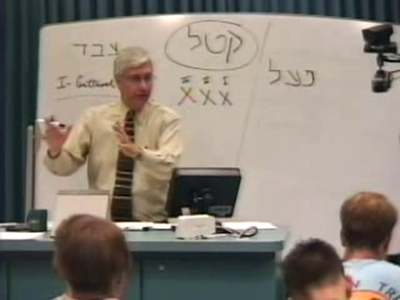
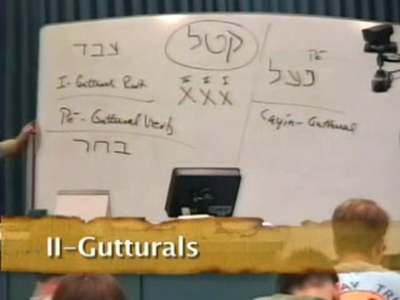
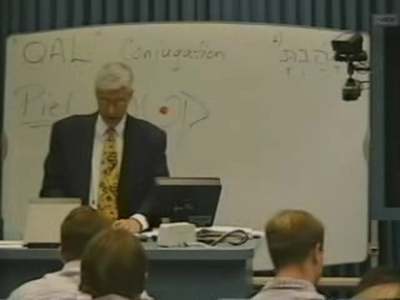
    The Pual II-Guttural is irregular.

  • 127. Chapter 20.3 by Andrew Bartelt

    127. Chapter 20.3

    Andrew Bartelt

    The Hithpael is the reflexive of the Piel.

  • 128. Chapter 20.3.A.1 by Andrew Bartelt

    128. Chapter 20.3.A.1

    Andrew Bartelt

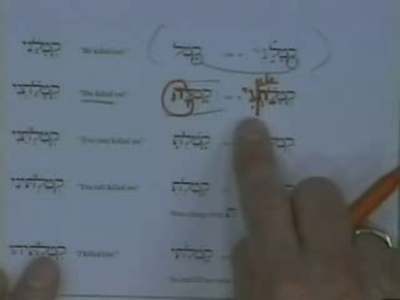
    The Hithpael perfect paradigm.

  • 129. Chapter 20.3.A.2 by Andrew Bartelt

    129. Chapter 20.3.A.2

    Andrew Bartelt

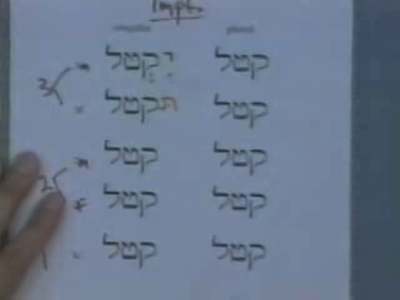
    The Hithpael imperfect and participle paradigms.

  • 130. Chapter 20.3.C.2 by Andrew Bartelt

    130. Chapter 20.3.C.2

    Andrew Bartelt

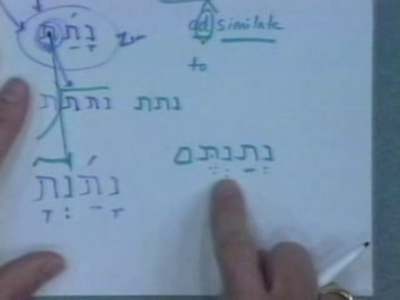
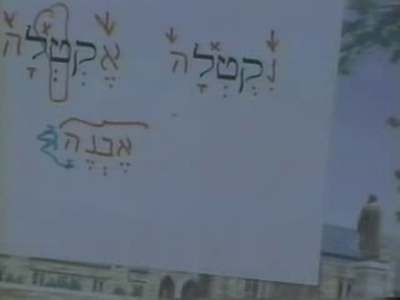
    Hithpael metathesis is when two letters change positions in Hithpael forms where the first root letter is a sibilant.

  • 131. Chapter 21 by Andrew Bartelt

    131. Chapter 21

    Andrew Bartelt

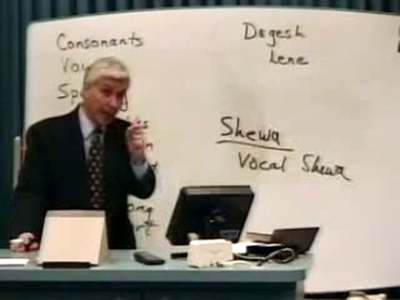
    More on Shewas.

  • 132. Chapter 21.1 by Andrew Bartelt

    132. Chapter 21.1

    Andrew Bartelt

    The Hophal is the passive of the Hiphil.

  • 133. Chapter 21.1.A.1 by Andrew Bartelt

    133. Chapter 21.1.A.1

    Andrew Bartelt

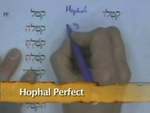
    The Hophal perfect paradigm.

  • 134. Chapter 21.1.A.2 by Andrew Bartelt

    134. Chapter 21.1.A.2

    Andrew Bartelt

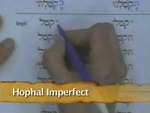
    The Hophal imperfect paradigm.

  • 135. Chapter 21.1.A.4 by Andrew Bartelt

    135. Chapter 21.1.A.4

    Andrew Bartelt

    The Hophal participle paradigm.

  • 136. Chapter 21.1.B by Andrew Bartelt

    136. Chapter 21.1.B

    Andrew Bartelt

    Example of how the Hophal is used, as the passive of the causative.

  • 137. Chapter 21.1.C.1 by Andrew Bartelt

    137. Chapter 21.1.C.1

    Andrew Bartelt

    The Hophal I-Guttural is irregular.

  • 138. Chapter 21.1.C.2 by Andrew Bartelt

    138. Chapter 21.1.C.2

    Andrew Bartelt

    The Hophal I-Nun is irregular.

  • 139. Chapter 21.1.C.3 by Andrew Bartelt

    139. Chapter 21.1.C.3

    Andrew Bartelt

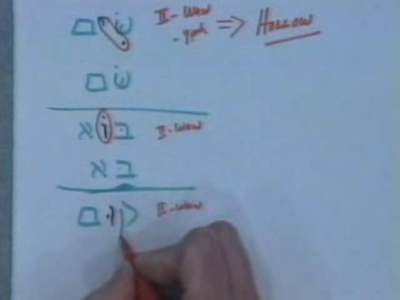
    The Hophal I-Yod and Hophal Hollow are irregular.

  • 140. Chapter 21.4 by Andrew Bartelt

    140. Chapter 21.4

    Andrew Bartelt

    There is a special Qal Passive Participle.

  • 141. Chapter 22.1 by Andrew Bartelt

    141. Chapter 22.1

    Andrew Bartelt

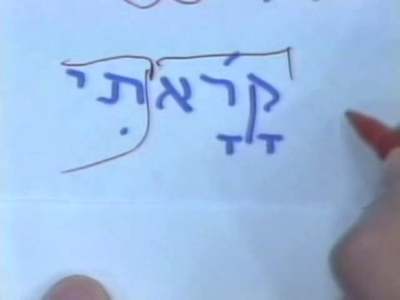
    Geminate verbs have "twin" letters for the second and third root letters. Geminate verbs are highly irregular.

  • 142. Chapter 22.1.A.1 by Andrew Bartelt

    142. Chapter 22.1.A.1

    Andrew Bartelt

    The Geminate Qal perfect paradigm.

  • 143. Chapter 22.1.A.2 by Andrew Bartelt

    143. Chapter 22.1.A.2

    Andrew Bartelt

    The Geminate Qal imperfect paradigm.

  • 144. Chapter 22.2 by Andrew Bartelt

    144. Chapter 22.2

    Andrew Bartelt

    The Polel is a substitute for the Piel, when there is a problem doubling the middle root letter, such as with hollows.

  • 145. Chapter 22.1.C by Andrew Bartelt

    145. Chapter 22.1.C

    Andrew Bartelt

    The Geminate Hiphil perfect and imperfect paradigm.

  • 146. Chapter 22.3 by Andrew Bartelt

    146. Chapter 22.3

    Andrew Bartelt

    A Verbal Hendiadys ("one through two") is when two verb forms are used to express one verbal idea.
  • 147. Chapter 23 by Andrew Bartelt

    147. Chapter 23
    Andrew Bartelt

    An introduction to Hebrew Numbers.

 
  • 1
  • 2
  • 3
  • 4
  • 5
  • 6


Browse

  • Collections
  • Disciplines
  • Authors

Search

Advanced Search

  • Notify me via email or RSS

Author Corner

  • Author FAQ

801 Seminary Place
St. Louis, Missouri 63105
314.505.7000

  • Facebook Link
  • Twitter Link
  • Instagram Link
  • RSS Link
 
Elsevier - Digital Commons
Concordia Seminary

Home | About | FAQ | My Account | Accessibility Statement

Privacy Copyright