
• Home
  • Search
  • Browse Collections
  • My Account
  • About
  • DC Network Digital Commons Network™
Skip to main content
Scholarly Resources from Concordia Seminary

Scholarly Resources from Concordia Seminary

  • Home
  • About
  • FAQ
  • My Account

Home > Seminary Courses > Elementary Greek

Elementary Greek

Elementary Greek


The essentials of Greek morphology, syntax, and vocabulary taught Dr. Voelz.

Printing is not supported at the primary Gallery Thumbnail page. Please first navigate to a specific Image before printing.

Follow

Switch View to Grid View Slideshow
 
  • Chapter 31.B.1.b by James Voelz

    Chapter 31.B.1.b

    James Voelz

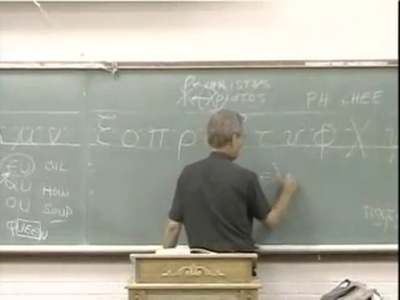
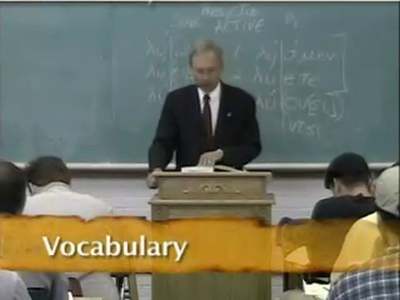
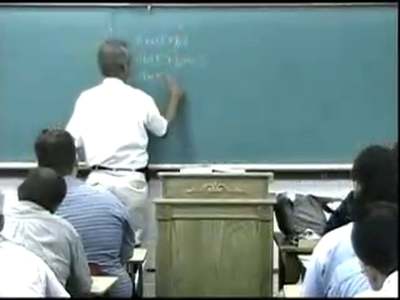
    Morphology for middle/passive present (-ow) contract verbs.

  • Chapter 31.B.1.e by James Voelz

    Chapter 31.B.1.e

    James Voelz

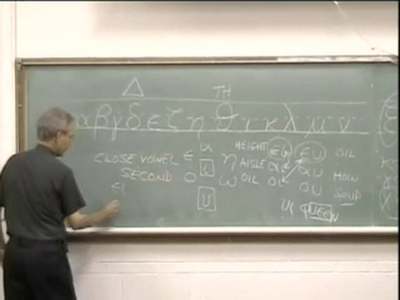
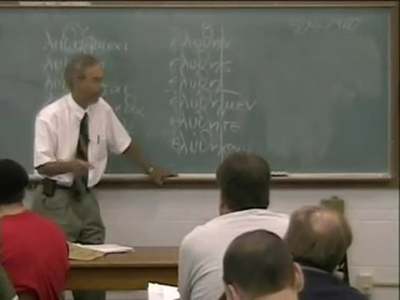
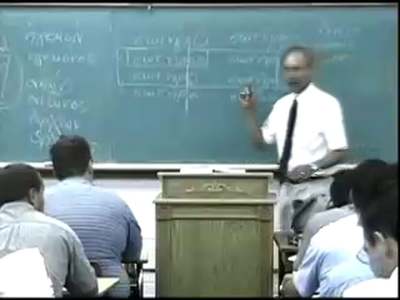
    Morphology for imperfect (-ow) contract verbs.

  • Chapter 32.A by James Voelz

    Chapter 32.A

    James Voelz

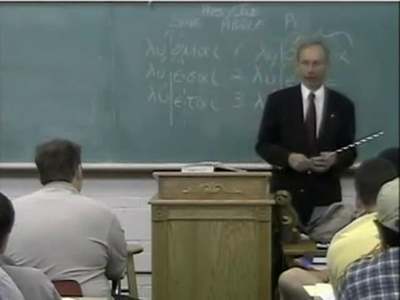
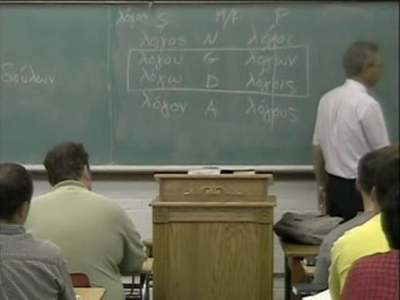
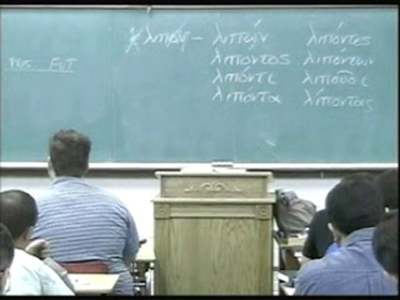
    The difference between second person and third person imperatives.

  • Chapter 32.C by James Voelz

    Chapter 32.C

    James Voelz

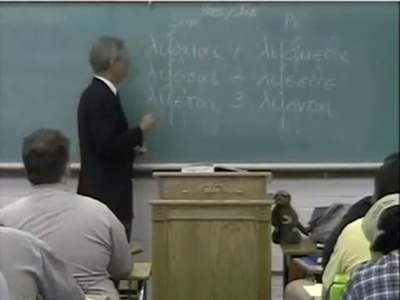
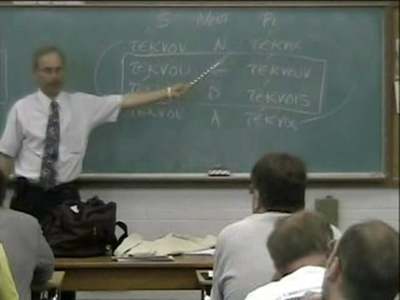
    Morphology for the imperative mood.

  • Chapter 32.F.1.a by James Voelz

    Chapter 32.F.1.a

    James Voelz

    Imperatives can command either "stop" or "don't start."

  • Chapter 32.F.1.b by James Voelz

    Chapter 32.F.1.b

    James Voelz

    Policy commands are translated with either "always" or "never."

  • Chapter 32.F.2 by James Voelz

    Chapter 32.F.2

    James Voelz

    There is a difference between specified case commands and policy commands.

  • Chapter 33.A by James Voelz

    Chapter 33.A

    James Voelz

    Introduction to (-mi) verbs.

  • Chapter 33.B.1.f by James Voelz

    Chapter 33.B.1.f

    James Voelz

    Morphology of active voice (-mi) verbs.

  • Chapter 33.B.3.a by James Voelz

    Chapter 33.B.3.a

    James Voelz

    Morphology of active voice (-mi) verbs, continued.

  • Chapter 34 by James Voelz

    Chapter 34

    James Voelz

    Morphology and examples of midde/passive voice (-mi) verbs.

  • Chapter 34.A by James Voelz

    Chapter 34.A

    James Voelz

    Introduction to midde/passive voice (-mi) verbs.

  • Chapter 34.B.3,B.5 by James Voelz

    Chapter 34.B.3,B.5

    James Voelz

    Morphology of aorist passive (-mi) verbs.

  • Chapter 35.A by James Voelz

    Chapter 35.A

    James Voelz

    The verb "histaymi" is both transitive and intransitive.

  • Chapter 35.B by James Voelz

    Chapter 35.B

    James Voelz

    The verb "histaymi" is one of the most frequent verbs in the New Testament.

  • Chapter 35.E by James Voelz

    Chapter 35.E

    James Voelz

    The meaning and significance of the verb "histaymi."

  • Chapter 36.C by James Voelz

    Chapter 36.C

    James Voelz

    Comparative adjectives and adverbs.

  • Chapter 36.C.3 by James Voelz

    Chapter 36.C.3

    James Voelz

    The syntax of comparatives.

  • Chapter 36.D by James Voelz

    Chapter 36.D

    James Voelz

    Superlative adjectives and adverbs.

  • Chapter 37.B by James Voelz

    Chapter 37.B

    James Voelz

    The vocative case is used for nouns of direct address.

  • Chapter 37.D by James Voelz

    Chapter 37.D

    James Voelz

    Various uses of the genitive case.

  • Chapter 37.E by James Voelz

    Chapter 37.E

    James Voelz

    Various uses of the dative case.

  • Chapter 37.F by James Voelz

    Chapter 37.F

    James Voelz

    Various uses of the accusative case.

  • Chapter 38.A by James Voelz

    Chapter 38.A

    James Voelz

    The optative mood is used for future situations that are improbable, but still possible.
  • Chapter 38.B by James Voelz

    Chapter 38.B

    James Voelz

    Morphology of optative mood verbs.

 
  • 1
  • 2
  • 3
  • 4
  • 5
  • 6
  • 7


Browse

  • Collections
  • Disciplines
  • Authors

Search

Advanced Search

  • Notify me via email or RSS

Author Corner

  • Author FAQ

801 Seminary Place
St. Louis, Missouri 63105

314.505.7000

  • Facebook Link
  • Twitter Link
  • Instagram Link
  • RSS Link
 
Elsevier - Digital Commons
Concordia Seminary

Home | About | FAQ | My Account | Accessibility Statement

Privacy Copyright